Gapers Block published from April 22, 2003 to Jan. 1, 2016. The site will remain up in archive form. Please visit Third Coast Review, a new site by several GB alumni. ✶ Thank you for your readership and contributions. ✶
I'm the idiot who waits until the year actually ends before rolling out my Best Of... list every year, and that's because I'm often able to squeeze in a dozen or more films in the last couple weeks of December, mostly stuff that others have told me is worth checking out that I either missed when it came out in Chicago or titles that simply never came out locally.
By my count, I saw 455 films in 2015 (10 less than last year — I'm slipping!), either in a theater or via screener — from Paddington to Point Break. This number does include a few vintage titles, but only if I saw them in a theater (often as a restored print, but not always). If I simply watched an older film at home, that doesn't make the list. As I do every year, I've separated out the documentaries because I want an excuse to call extra attention to a whole other batch of worthy films (20 this year) that might go unnoticed on my main list. Plus, it's always seemed strange to me to mix docs and features; the same way you don't usually see fiction and nonfiction books shelved together in a bookstore.
I think I'll take the plunge and write the last post on Gapers Block before it goes on hiatus in an hour or so. I've been A/C page editor for a year and theater/arts writer for almost three years. Shorter tenure than many of the veteran GB writers, but I have written 284 posts during that time. I'm going to miss Gapers Block very much. It has been invigorating intellectually and emotionally to have a place to write regularly about the arts I love--theater, art, design, architecture, sometimes books or music.
My first post was in May 2013 for the Book Club page. It was a feature on Richard Hell, the punk rock performer of the '70s, best known for his "Please Kill Me" shirt. He talked, answered questions and signed copies of his new book (I Dreamed I Was a Very Clean Tramp) at the Book Cellar on Lincoln Avenue and I felt fortunate to see the bass player and singer with the Voidoids, Television and the Heartbreakers. The fact that the Book Club editor let me write a feature about him made it even more rewarding.
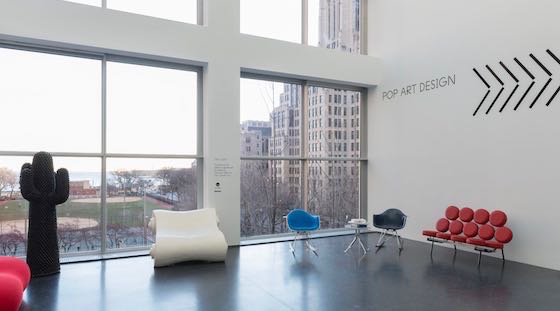
Pop Art Design exhibition view. Photos by Nathan Keay.
It may be your father's pop art, but the work shown in the new exhibit at the Museum of Contemporary Art is still fresh and fun. The art that shocked the elite art world 50 years ago still has a story to tell today.
The new Pop Art Design exhibit at the MCA pairs 150 art works and design objects in an exhibit that sparkles with wit and irreverence. And it reminds you of how Andy Warhol's "Campbell soup can art" was first received with ridicule...by non-connoisseurs. That was just about the time that the elite collectors woke up and began buying Warhols.
For more than a few raving cinephiles, watching a Quentin Tarnatino film is a bit like going on a scavenger hunt through the filmmaker's personal movie library. It's a history lesson where the students (i.e. the audience) must teach themselves enough about a certain type of film history to catch all of the references. The danger of watching any movie this way is that some may get so excited about identifying the references that they mistake this sense of accomplishment for the film actually being good.
Fortunately for us, Tarantino cares more about creating richly drawn and downright freaky characters just a little bit more than he does trying to play guessing games. He's also become something of a master at crafting stories that not only make it damn near impossible to predict the ending, but the journey itself is an intricately woven garment made of stitching that never quite goes in a straight line and is just as much of a mystery.
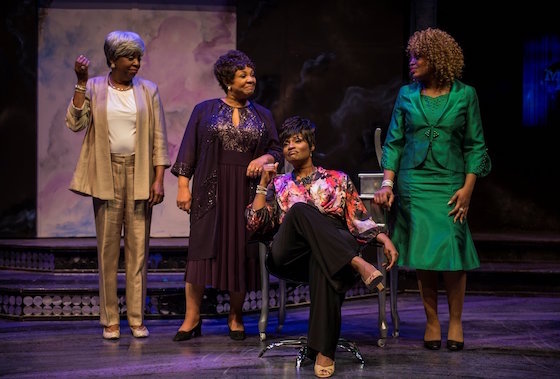
Preston, Addison, Dawan and McCullough. Photo by Michael Brosilow
Dynamite Divas, Black Ensemble Theater's contribution to holiday celebrations, is subtitled "A Tribute to Women of Soul." And it's a worthy tribute to those talented and charismatic singers, with performances of songs of the '60s and '70s by Roberta Flack (Melanie McCullough), Nancy Wilson (Rhonda Preston), Gladys Knight (Rashada Dawan) and Aretha Franklin (Shari Addison). The four performers sing powerfully and create realistic personas of their characters. Their songs alone would have earned four stars for the musical aspect of this show.
Unfortunately, that fine music is layered with a silly plotline about a billionaire inventor (Mr. Maurice, smarmily played by Rueben Echoles) and his worldwide telecast of the dynamite divas. Echoles, a multitalented artist, also directed, choreographed and designed costumes and wigs. The production, written and produced by BET's founder, Jackie Taylor, would be better off with less of Mr. Maurice and his story.
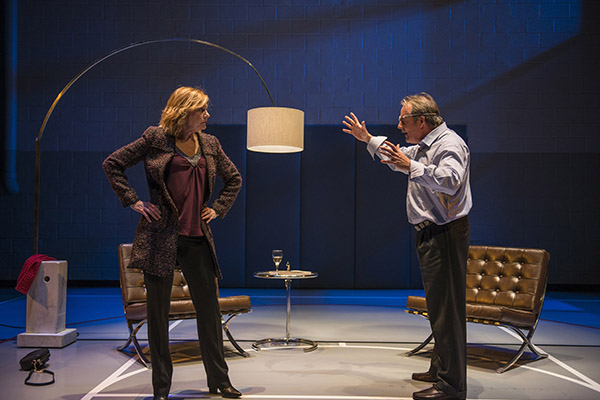
Mary Beth Fisher and Tom Irwin in Steppenwolf Theatre's Domesticated.
Domesticated opens with an all-too-familiar press conference you've seen both on cable news and in TV dramas: a middle-aged politician apologizing (or trying to, anyway) for a sex scandal as his wife looks on. Can Steppenwolf's Bruce Norris, the Pulitzer-winning playwright of Clybourne Park, turn one of our oldest tropes into an edgy conversation starter?
A lot can be said about the current film culture's emphasis on leaning heavily into the realm of nostalgia — not story, not character development, but simply giving audiences flashes of what we're familiar with and allowing that to pass for something new. Say what you want about his take on the Star Trek franchise, but I was at least happy that, by creating a time travel understory, J.J. Abrams effectively let it be known that anything could happen from this point forward. The possibility of opening up entirely different paths for the crew of the Enterprise was there, even if that's not exactly how it panned out.
In this retro climate, it should come as no surprise that the year's biggest box office hit (and one of the biggest of all time) is Jurassic World, which is so devoted to the original film, Jurassic Park, that it effectively pretends that the two other sequels simply never happened. And perhaps you noticed that Creed is also doing very well with fans of the original Rocky. Hmm...
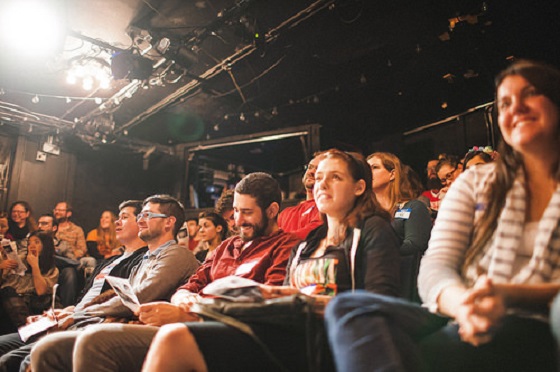
The Neo-Futurists, Chicago's acclaimed experimental theater group, closed out their second and final weekend of Best of 2015 shows on Sunday and they're getting ready for New Year's Eve with a special Too Much Light Makes the Baby Go Blind performance.
Their 27-year-running late night show, Too Much Light Makes the Baby Go Blind is seemingly as relevant and cutting edge as ever. Several of their Best of 2015 performances sold out and last week it was announced that the Neo-Futurists' Neo-Access Program and Neo-Futurist Kitchen Festival would receive grant funding from the National Endowment for the Arts.
Hubbard Street 2 dancer Adrienne Lispon. Photo by Todd Rosenberg.
Hubbard Street Dance Chicago presented a holiday treat this weekend with its Season 38 Winter Series, performed Thursday through Sunday.
The show consisted of two world premieres and one US premiere, as well as a Hubbard Street favorite.
The show featured the US premiere of Crystal Pite's Solo Echo, created for Nederlands Dans Theater in 2012. The piece is inspired by Mark Strand's poem, Lines for Winter.
The piece "presents a man reckoning with himself at the end of his life," said Pite. "The character is echoed--copied, reiterated, by seven different dancers. He is portrayed through both male and female bodies, and through various physiques and strengths. Each performer is a distinct and nuanced version of the character, and the connections between them evoke a man coming to terms with himself."
A music festival--or any concert, for that matter--is a conversation between the musicians on stage and the vast array of fans before them. But to this point, that conversation has really only been explored from the artists' perspective. There's a certain mystique that accompanies the art of live performance and garners the lion's share of critical attention, but much of that mystique stems from the electric energy generated by the crowd itself. FESTIVAL, a documentary produced and directed by North Coast Music Festival co-founder Mike Raspatello, delves into this side of the live music story and successfully captures the essence of the festival experience. I was fortunate enough to attend a pre-screening of the film at the New 400 Theaters in Rogers Park, and it made a powerful impression.
Beowulf & Grendel, a reading of a new adaptation of the classic story, will be presented by the Phantom Collective Sunday evening, Dec. 20, at Chief O'Neill's Pub & Restaurant.
Chicago author June Sawyers has combined Beowulf, the Old English epic poem, with Grendel, one of Beowulf's antagonists (dramatized in John Gardner's 1971 novel, Grendel, in which that character tells his side of the story).
Si Osborne directs actors Stephen O'Connell and Andrew Rathgeber, with music by Sean Cleland and sound design by John Szymanski.
In many ways, this unbelievable story about a vengeful whale attacking a vessel designed to kill it belongs in the hands of a director like Ron Howard, who is a master at always finding the right tone for a story rather than imposing the same style in every movie he makes. I might even argue that if you didn't know you were watching a Ron Howard movie, you might never figure it out until the end credit begin to roll. I certainly don't mean to imply that Howard has no distinguishing characteristics as a director. Quite the opposite: his finest trait is that he doesn't smear his fingerprints across every film he makes, he lets the subject matter dictate every aspect of his movies, and he usually gets it right.
"There is no greater agony than bearing an untold story inside you" -- Maya Angelou
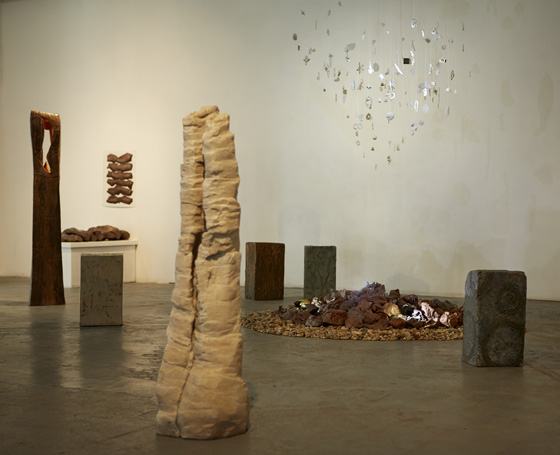
Exposing truth, sharing untold stories, and releasing traumatic adversity can serve as a mental and emotional cleansing. In The Cairn Project, by Corinne Peterson, participants from the Chicago area are invited to join in workshops where they handle clay and porcelain, and share their trauma in order to see their light. Individuals are instructed to create a "rock" from clay to represent their inner darkness or trauma, and then create a small token of light, which is made from porcelain. Once the workshop is finished, Peterson displays a mound from the clay "rocks" and installs the porcelain tokens as a cloud of hope above the cairn.
Currently at the Lillstreet Art Center, Peterson's exhibition, "Cairn & Cloud: A Collective Expression of Trauma and Hope", was created with participants from 60+ workshops and includes various clay sculptures which entice meditation and reflection.
I sat down with the artist on two of her meditation seats in the exhibition space and discussed the ideas behind The Cairn Project and the universality of trauma and hope.
Installation View, Zhou B Art Center, courtesy of the artist
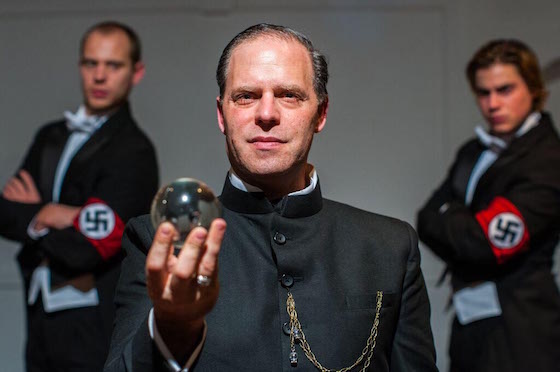
Palace of the Occult takes place at a 1933 Berlin society gathering and tells the story of the popular psychic, Erik Jan Hanussen, who later became Adolf Hitler's psychic adviser. The production is based on the life of an obscure character who may have played a significant role in World War II.
Neil Tobin, a Chicago performer, magician and psychic, wrote and performs Palace of the Occult, which takes place at the opening of the venue. He presides as Hanussen, the Jewish clairvoyant whose prophecies of victory gave Hitler confidence in his war strategy. Hanussen tells stories and performs magic and psychic demonstrations, some of which involve audience interaction. Jack Dryden, Carter Petray and David Weiner play other roles.
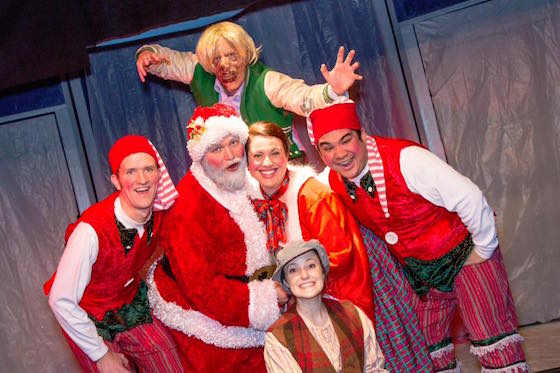
Maul Santa (The Musical), with book by Ricky Glore and music by J. Sebastian Fabal, is a cross-genre production that plays until Dec. 19. Featuring a "real life" Santa and Mrs. Claus (and their two-elf entourage), Maul Santa seeks to answer the question, "What if the legendary gift-giving figurehead of Christmas got trapped in a mall with a bunch of zombies during a zombie apocalypse?"
Funny idea. But as with most new productions, the devil is in the details, and the details here fall short.




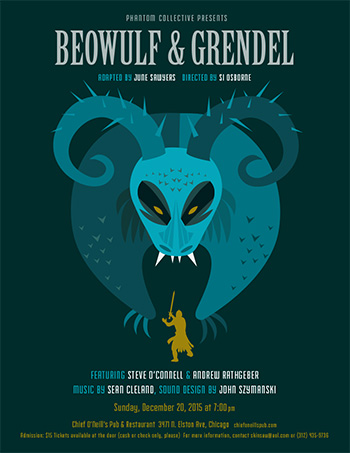 Beowulf & Grendel, a reading of a new adaptation of the classic story, will be presented by the Phantom Collective Sunday evening, Dec. 20, at Chief O'Neill's Pub & Restaurant.